Any object displaying the above mentioned characteristic is said to have a spherical shape. If the inside of the sphere is empty, it is referred to as a spherical shell or a hollow sphere. If the inside of the sphere is filled, it is called as a solid sphere . The unit of volume of a sphere is given as the 3.

The metric units of volume are cubic meters or cubic centimeters while the USCS units of volume are, cubic inches or cubic feet. The volume of sphere depends on the radius of the sphere, hence changing it changes the volume of the sphere. There are two types of spheres, solid sphere, and hollow sphere. The volume of both types of spheres is different.
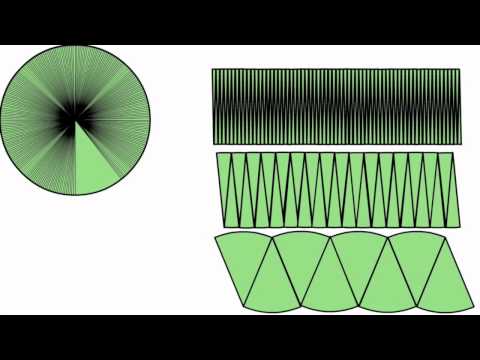
We will learn in the following sections about their volumes. To find the volume of a sphere, we can calculate the volume by using a simple volume formula where we multiply 4/3 by pi by the radius cubed. The volume of sphere formula is unique because it only requires the radius to calculate the volume of any sphere. When finding the volume of spheres, it is important to note if we are given the radius or the diameter of the shape. This formula is very similar to other prism volume formulas. For drawing a circle on a sheet of paper, take a circular disc, paste a string along its diameter and rotate it along the string and this will give the shape of a sphere.

The balls that are used in these sports are nothing but spheres of different radius. The volume of sphere formula is also useful in designing and calculating the capacity or volume of such spherical objects. This online calculator will calculate the 3 unknown values of a sphere given any 1 known variable including radius r, surface area A, volume V and circumference C. It will also give the answers for volume, surface area and circumference in terms of PI π.

A sphere is a set of points in three dimensional space that are located at an equal distance r from a given point . A sphere is a three-dimensional, round object, such as a marble or soccer ball. The volume represents the space enclosed by the object.
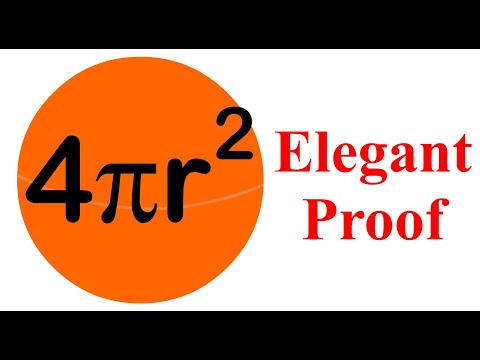
The formula for the volume of a sphere is 4/3 times pi times the radius cubed. Cubing a number means multiplying it by itself three times, in this case, the radius times the radius times the radius. To find the volume in terms of pi, leave pi in the formula rather than converting it to 3.14. The volume of a Sphereis the amount of space contained by a sphere. The volume is calculated by the integration method and measured in cubic units. The volume of a sphere equals four-thirds of the product of \(\pi \) and the cube of the radius.
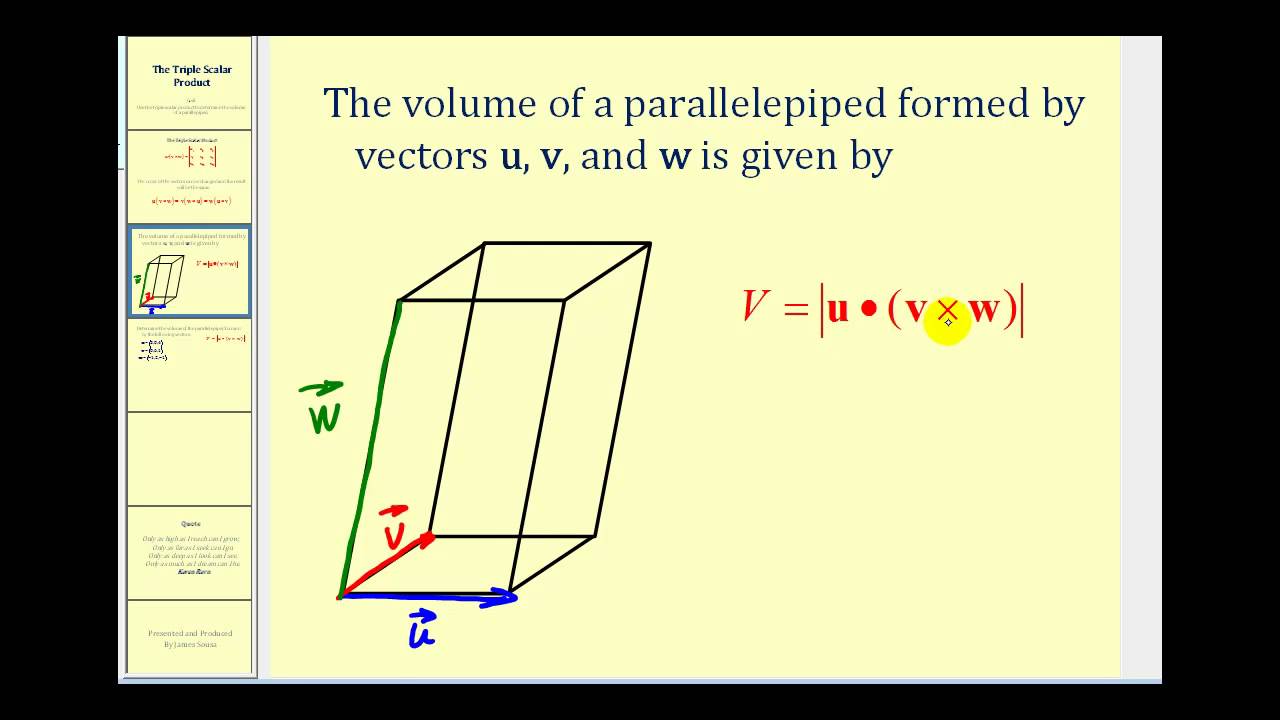
A sphere is a three-dimensional solid with no base, no edge, no face and no vertex. Sphere is a round body with all points on its surface equidistant from the center. The volume of a sphere is measured in cubic units.
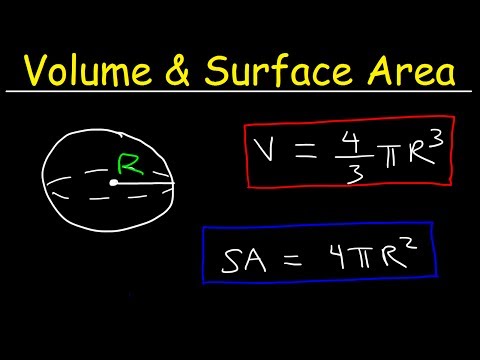
The volume of a sphere is the amount of space occupied by it. For a hollow sphere like a football, the volume can be viewed as the number of cubic units required to fill up the sphere. Now the question becomes calculating the volume of the bicylinder . It is also very difficult, so add a cube packing the bicylinder . Now when the plane intersects the cube, it forms another larger square. The extra area in the large square , is the same as 4 small squares .
Moving through the whole bicylinder generates a total of 8 pyramids. So volume is equal to 288 pi and then we have to write in our units, cubic centimetres. So there's only one dimension you need to know in order to calculate the volume of a sphere and that is your radius.

In this problem we had to divide 12 in half because there was a diameter so we could substitute and find our volume. The volume of a sphere is the three-dimensional space occupied by a sphere. This volume depends on the radius of the sphere (i.e, the distance of any point on the surface of the sphere from its center).

If we take the cross-section of the sphere then the radius can be calculated by reducing the length of the diameter to its half. Or we can also say that the radius is half of the diameter. A circle can be drawn on paper but a sphere can't be drawn on a piece of paper. This is because Circle is a two-dimensional figure whereas a sphere is a three-dimensional object, for example- Ball, Earth, etc. A Sphere is a 3D figure whose points lie in space.

All the points on the surface of a sphere are equidistant from its centre. This distance from the surface to the centre is called the radius of the sphere. Let the inside of a sphere of radius r be composed of n square pyramids, each with a height of r and a base with an area of A. The apex of each pyramid is at the center of the sphere, as shown below. The size of the sphere determines the volume of the sphere and is based on the radius.

The more the radius, the more the volume would be. A sphere has three axes- the X-axis, Y-axis and Z-axis. Some known examples for sphere include basketball, football, globe, etc.
Let us learn more about the volume of a sphere, its formula, derivation and its types. Now something that you should notice is that we have r to the third which reminds you that we are talking about volume and not a surface area. So we said that r is going to be half of 12, since 12 is our diameter. So volume equals four thirds times pi times 6 cubed.

Volume Of A Sphere Differential Equation So we say volume is equal to four thirds pi times 216. I'm going to multiply four thirds by 216 on my calculator. I should end up with some number larger than 216 and I do. So let's look at a quick example about how we could use that formula. Here we have a sphere and we're being asked to find its volume. Now notice that what they give you is not a radius but a diameter.

So we're going to start off by writing our formula, volume equals four thirds pi times your radius cubed. The volume of a sphere is determined by the three coordinates x, y, and z. Because a three-dimensional object will lie on all three axes. Volume is measured in cubic meters, cubic feet, cubic inches, and similar units. It is represented by symbols cm3, m3, in3, and so on. The volume of sphere formula can be given for a solid as well as the hollow sphere.

The volume of a sphere is the measurement of the space it can occupy. A sphere is a three-dimensional shape that has no edges or vertices. In this short lesson, we will learn to find the volume of a sphere, deduce the formula of volume of a sphere and learn to apply the formulas as well. Once you understand this chapter you will learn to solve problems on the volume of the sphere. The volume of a 3 -dimensional solid is the amount of space it occupies.
Be sure that all of the measurements are in the same unit before computing the volume. This statement is not at all obvious or elementary. "A sphere's volume is two cones of equal height and radius to that of the sphere's".
The assertion about the cone and the cylinder is a little easier to prove, but it too is not obvious. So you have not really provided an answer to this to year old question. I think the accepted answer is closest to what you have in mind. If you want to help here I think you should pay attention to new questions that don't yet have answers. The volume calculator is able to do symbolic calculations in other words to do literal calculations.

To calculate, for example, the volume of a sphere of radius 1 + x, you must enter the following formula volume_sphere(`1+x`), after calculating the result is returned. Thus, calculating the volume of a sphere of radius 3 is done by typing the following formula volume_sphere(`3`). When a sphere is cut by a plane that passes through its center, the intersection of the sphere and the plane is called a great circle. Another way to think of this is that a great circle of a sphere is a circle that cuts the sphere exactly in half, forming two hemispheres. This means that the radius of the great circle will also be the radius of the sphere .

A surface has no volume, hence, we prefer to refer to it as a ball. A circle is a two-dimensional shape that can be quickly drawn on a piece of paper. On the other hand, a sphere is three-dimensional, like a football or a basketball. The three coordinate axes, -axis, -axis and -axis, define the shape of a sphere. Like a circle, the sphere also has a centre point.

The pi in the formula is the constant that we use when finding the circumference of a circle, and the radius, as you might remember, is half the length of the diameter. This relates to the fact that in the end we are solving for volume, which has three dimensions. The geometry of the sphere was studied by the Greeks. The volume and area formulas were first determined in Archimedes's On the Sphere and Cylinder by the method of exhaustion. Zenodorus was the first to state that, for a given surface area, the sphere is the solid of maximum volume. The angle between two spheres at a real point of intersection is the dihedral angle determined by the tangent planes to the spheres at that point.

Two spheres intersect at the same angle at all points of their circle of intersection. They intersect at right angles if and only if the square of the distance between their centers is equal to the sum of the squares of their radii. Although the Earth is not perfectly spherical, terms borrowed from geography are convenient to apply to the sphere.

If a particular point on a sphere is designated as its north pole, its antipodal point is called the south pole. The great circle equidistant to each is then the equator. Great circles through the poles are called lines of longitude or meridians. A line connecting the two poles may be called the axis of rotation. Small circles on the sphere that are parallel to the equator are lines of latitude. In geometry unrelated to astronomical bodies, geocentric terminology should be used only for illustration and noted as such, unless there is no chance of misunderstanding.

The sphere is a fundamental object in many fields of mathematics. Spheres and nearly-spherical shapes also appear in nature and industry. Bubbles such as soap bubbles take a spherical shape in equilibrium. The Earth is often approximated as a sphere in geography, and the celestial sphere is an important concept in astronomy. Manufactured items including pressure vessels and most curved mirrors and lenses are based on spheres.

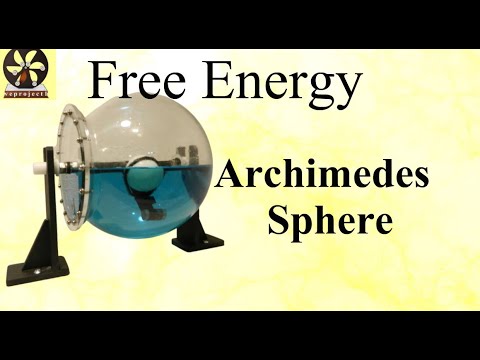
Spheres roll smoothly in any direction, so most balls used in sports and toys are spherical, as are ball bearings. Volume is a fixed quantity and can be found using Archimedes' principle. According to Archimedes, if the solid sphere is dropped in the container filled with water, the volume of water displaced will be equal to the volume of the sphere. The volume will change when the values of the diameter or radius of the sphere will change. Otherwise, the formula for the volume of the sphere will remain the same. 7Given a solid sphere of radius R, remove a cylinder whose central axis goes through the center of the sphere.

The online calculator allows to calculate the volume of a sphere from its radius. For example, if the radius of your sphere equals 19 inches, multiply 19 by 19 to get 361 square inches. The ball with ice cream inside is an example of a solid sphere and when the ice cream is eaten out, the empty ball is an example of the hollow sphere. In this article, we will learn the details of the volume of a sphere, its definition, formula or equation calculation, unit in Gallons or liters, along with so many examples. The points on the sphere are all the same distance from a fixed point. Also, the ratio of the distance of its points from two fixed points is constant.The first part is the usual definition of the sphere and determines it uniquely.
The second part can be easily deduced and follows a similar result of Apollonius of Perga for the circle. In geometric terms, a sphere is defined as a set of points that are a given distance from a given point. A spherical solid metal of a radius of $16$ inches is melted down into a cube.

Use $\pi \approx 3.14$ and estimate your answer to the nearest whole number. Or it will be right to say a 3D version of a circle. In geometry, a sphere is a 3-dimensional round solid figure in which every point on its surface is equidistant from its center. The formula for measuring the volume of a sphere is (4/3)πr3. We can simply measure the volume of any spherical shell by substituting the values of the parameters like radius and diameter in the volume formula.

Let us take an example to learn how to calculate the volume of sphere using its formula. The volume V of a sphere is four-thirds times pi times the radius cubed. Browse other questions tagged geometry volume solid-geometry spheres or ask your own question.


No comments:
Post a Comment
Note: Only a member of this blog may post a comment.